Gilbert Ryle
British philosopher who critiqued Cartesian dualism.

Gilbert Ryle (19 August 1900 – 6 October 1976) was a British philosopher, principally known for his critique of Cartesian dualism, for which he coined the phrase 'ghost in the machine'. Some of Ryle's ideas in philosophy of mind have been called logical behaviourist. In his best-known book, The Concept of Mind (1949), he writes that the 'general trend of this book will undoubtedly, and harmlessly, be stigmatised as "behaviourist".' Having studied the philosophers Bernard Bolzano, Franz Brentano, Alexius Meinong, Edmund Husserl, and Martin Heidegger, Ryle suggested that the book instead 'could be described as a sustained essay in phenomenology, if you are at home with that label.'
- born
- 19 August 1900, Brighton, England
- died
- 6 October 1976, Whitby, North Yorkshire
- field
- Philosophy
- nationality
- British
- known_for
- Critique of Cartesian dualism, 'ghost in the machine', The Concept of Mind, know
Verified Timeline
Lore & Background
Gilbert Ryle was born in Brighton, England, on 19 August 1900, and grew up in an environment of learning. He was educated at Brighton College and in 1919 went up to The Queen's College at Oxford to study classics, but was soon drawn to philosophy. He graduated with a 'triple first'; he received first-class honours in classical Honour Moderations (1921), literae humaniores (1923), and philosophy, politics, and economics (1924). In 1924, Ryle was appointed lecturer in philosophy at Christ Church, Oxford. A year later, he became a fellow and tutor at Christ Church, where he remained until 1940. In the Second World War, Ryle was commissioned in the Welsh Guards. A capable linguist, he was recruited into intelligence work and by the end of the war had been promoted to the rank of Major. After the war he returned to Oxford and was elected Waynflete Professor of Metaphysical Philosophy and Fellow of Magdalen College, Oxford. He published The Concept of Mind in 1949. He was president of the Aristotelian Society from 1945 to 1946, and editor of the philosophical journal Mind from 1947 to 1971. Ryle died on 6 October 1976 at Whitby, North Yorkshire. Ryle's brothers John Alfred (1889–1950) and George Bodley (1902–1978), both educated at Brighton College, also had eminent careers. John became Regius Professor of Physic at the University of Cambridge and physician to King George V. George, after serving as Director of Forestry first for Wales and then England, was Deputy-Director of the Forestry Commission and appointed a CBE. Ryle was the subject of a portrait by Rex Whistler, which he said made him look like 'a drowned German General'. Michael Dummett recalls Ryle's complaint, adding 'but that was exactly what he did look like'. In retirement he lived with his twin sister Mary. He was a lifelong bachelor, and never married.
Reader's Guide
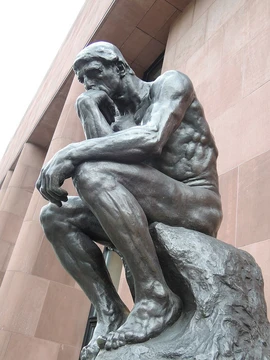
Ryle's significance lies in his influential critique of Cartesian dualism, which he attacked as involving category mistakes and philosophical nonsense in The Concept of Mind. He argued that dualism posits a 'ghost in the machine'. His distinction between 'knowing-how' and 'knowing-that' has attracted independent interest and is the origin of procedural and declarative models of long-term memory; this distinction is widely accepted in philosophy. Ryle analogised philosophy to cartography, aiming to rectify the 'logical geography of the knowledge we already possess'. He introduced the notion of 'thick description' in 1968 in 'The Thinking of Thoughts: What is "Le Penseur" Doing?' and 'Thinking and Reflecting', distinguishing thin description (surface-level observations of behaviour) from thick description (adding context and understanding motivations). This notion has been an important influence on cultural anthropologists such as Clifford Geertz. Although his views were challenged by the rise of cognitivism in the 1960s and 1970s, philosopher Daniel Dennett, a student of Ryle's, has said that recent trends in psychology such as embodied cognition, discursive psychology, and situated cognition have provoked a renewed interest in Ryle's work. Dennett provided a sympathetic foreword to the 2000 edition of The Concept of Mind.
Did You Know?
- Ryle coined the phrase 'ghost in the machine' for his critique of Cartesian dualism.
- He graduated with a 'triple first': first-class honours in classical Honour Moderations (1921), literae humaniores (1923), and philosophy, politics, and economics (1924).
- During the Second World War, Ryle was commissioned in the Welsh Guards, recruited into intelligence work, and promoted to Major.
- Ryle's brother John Alfred Ryle became Regius Professor of Physic at the University of Cambridge and physician to King George V.
- Ryle was the subject of a portrait by Rex Whistler, which he said made him look like 'a drowned German General'.
Frequently Asked Questions
Who is Gilbert Ryle?
Gilbert Ryle was a British philosopher born in Brighton in 1900 who became one of the most influential thinkers in the philosophy of mind. He is best remembered for dismantling the traditional mind-body dualism inherited from Descartes. He passed away in Whitby, North Yorkshire, in 1976.
What does the phrase "ghost in the machine" mean?
Ryle coined this expression to mock the idea that a non-physical mind (the ghost) operates inside the physical body (the machine). He argued that picturing a separate mental entity as the true agent behind our actions is a confused and incoherent way of thinking about human beings. The phrase became one of the most recognizable images in twentieth-century philosophy.
What is The Concept of Mind?
Published in 1949, The Concept of Mind is Ryle's major book in which he systematically attacks the Cartesian picture of the mind as a private, inner theatre. He argues that many so-called mental states are really just dispositions to behave in particular ways. The work is widely regarded as a foundational text of ordinary language philosophy.
What is the difference between "knowing-how" and "knowing-that"?
Ryle distinguished between practical skill, such as knowing how to ride a bicycle, and propositional knowledge, such as knowing that a certain rule applies. He contended that much of what people call understanding is really competence that cannot be reduced to a list of explicit facts. This distinction challenged the assumption that all knowledge must be expressible as a set of rules.
Why is Gilbert Ryle important to philosophy?
Ryle helped shift the entire field of philosophy of mind away from treating the mind as a separate substance and toward analyzing how we actually talk about mental life. His work laid important groundwork for the ordinary language movement and influenced later thinkers in both analytic philosophy and cognitive science. He remains a central reference point whenever the mind-body problem is discussed.
More in Philosophers 1-24
Elsewhere in the Philosophers universe
Spotted an error? Know more?
This is a living reference — every entry is fact-audited, and reader corrections feed straight into our audit queue. Suggest an edit · See this site's audit record