
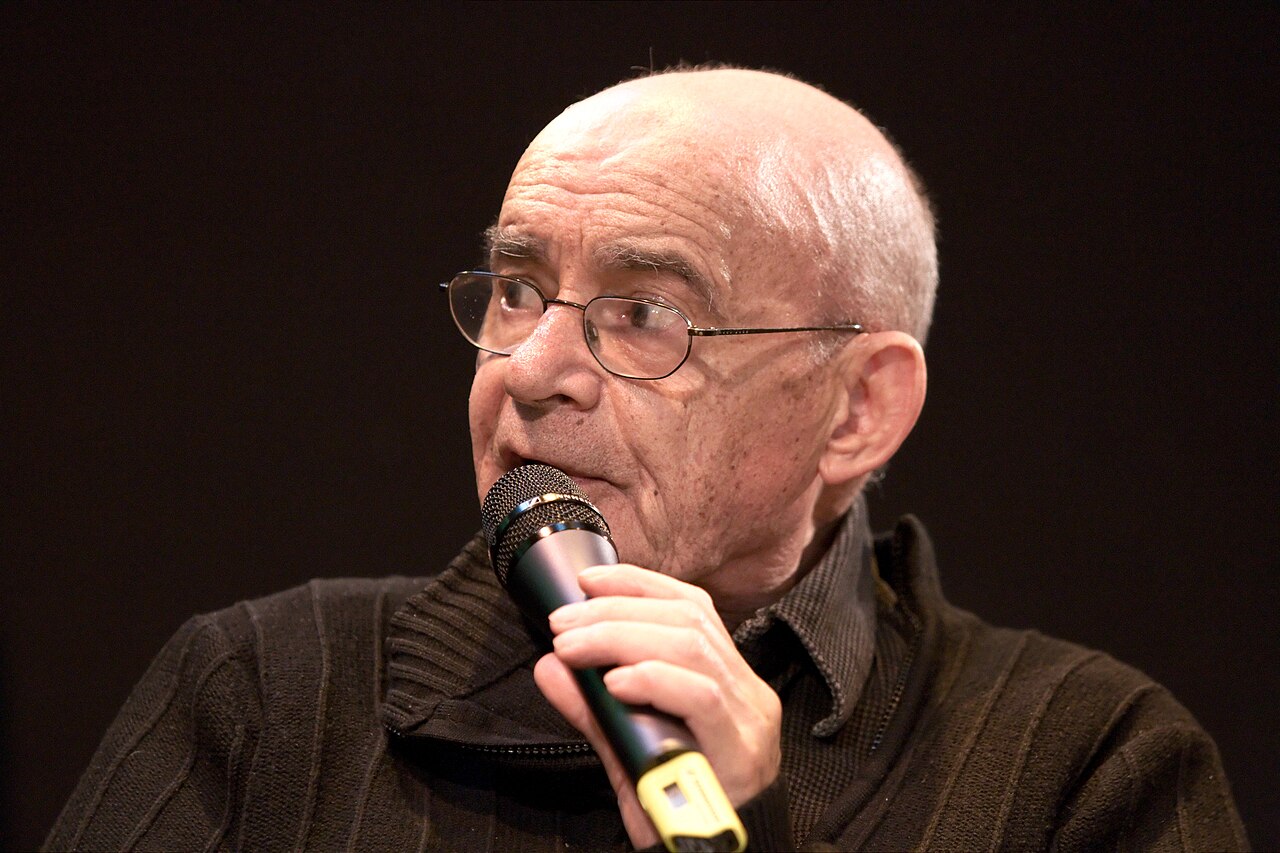
Jean-Luc Nancy
French philosopher known for rethinking community and politics.

ActuaLitté · CC BY-SA 2.0
Jean-Luc Nancy (26 July 1940 – 23 August 2021) was a French philosopher. His first book, published in 1973, was *Le titre de la lettre* (The Title of the Letter, 1992), a reading of the work of French psychoanalyst Jacques Lacan, written in collaboration with Philippe Lacoue-Labarthe. Nancy is the author of works on many thinkers, including *La remarque spéculative* in 1973 (The Speculative Remark, 2001) on Georg Wilhelm Friedrich Hegel, *Le Discours de la syncope* (1976) and *L'Impératif catégorique* (1983) on Immanuel Kant, *Ego sum* (1979) on René Descartes, and *Le Partage des voix* (1982) on Martin Heidegger. He is credited with helping to reopen the question of the ground of community and politics with his 1985 work *La communauté désoeuvrée* (The Inoperative Community).
- born
- 26 July 1940
- died
- 23 August 2021
- field
- Philosophy
- nationality
- French
- known_for
- The Inoperative Community, work on community and politics, collaboration with Ph
Verified Timeline
Lore & Background
Jean-Luc Nancy graduated in philosophy in 1962 from the University of Paris. He taught for a short while in Colmar before becoming an assistant at the Strasbourg Institut de Philosophie in 1968. In 1973, he received his doctorate with a dissertation on Kant under the supervision of Paul Ricœur. Nancy was then promoted to Maître de conférences (associate professor) at the Université des Sciences Humaines de Strasbourg. In the 1970s and 1980s, Nancy was a guest professor at universities all over the world, from the University of California to the Freie Universität in Berlin. He has been invited as a cultural delegate of the French Ministry of External Affairs to speak in Eastern Europe, Britain and the United States. In 1987, Nancy became a Docteur d'État at the Université de Toulouse-Le-Mirail for a thesis on freedom in Heidegger under the supervision of Gérard Granel. The jury was composed of Jean-François Lyotard and Jacques Derrida. It was published as *L'expérience de la liberté* (1988). In the late 1980s and early 1990s, Nancy suffered serious medical problems. He underwent a heart transplant and his recovery was made more difficult by a long-term cancer diagnosis. He stopped teaching and participating in almost all of the committees with which he was engaged, but continued to write. Many of his best-known texts were published during this time. An account of his experience, *L'intrus* (The Intruder), was published in 2000. Nancy was a professor at the University of Strasbourg. Nancy was also Wilhelm Friedrich Hegel Chair and Professor of Philosophy at The European Graduate School. Nancy died on 23 August 2021 at the age of 81.
Reader's Guide
Nancy's significance lies in his sustained engagement with the question of community and politics, particularly through his 1985 work *La communauté désoeuvrée*, which followed Maurice Blanchot's *The Unavowable Community* (1983) and prompted a response from Giorgio Agamben with *The Coming Community* (1990). His collaboration with Philippe Lacoue-Labarthe was extensive, including the 1980 conference 'Les Fins de l'homme' at Centre culturel international de Cerisy-la-Salle, which solidified Jacques Derrida's place in contemporary philosophy and was a place to begin an in-depth conversation between philosophy and contemporary politics. Nancy and Lacoue-Labarthe also set up the Centre de Recherches Philosophiques sur la Politique (Centre for Philosophical Research on the Political) in the same year, dedicated to pursuing philosophical rather than empirical approaches to political questions. By 1984, however, they were dissatisfied with the direction work at the centre was taking, and it was closed down. Nancy's work on freedom, published as *L'expérience de la liberté* (1988), treated freedom as a property of the individual or collectivity, and looked for a 'non-subjective' freedom which would attempt to think the existential or finite origin for every freedom. In *Le sens du monde* (1993), he addressed the world in its contemporary global configuration, asking what we mean by saying that we live in one world. In his 2002 book *La création du monde ou la mondialisation*, he made the distinction between globalization as a deterministic process and mondialisation as an open-ended 'world-forming' process. Nancy's influence extended beyond philosophy: filmmaker Claire Denis has made at least two movies inspired by Jean-Luc Nancy and his works, and he collaborated with artists such as Simon Hantaï, Soun-gui Kim and Phillip Warnell. Jacques Derrida wrote one of his very few monographs on a contemporary philosopher, *On Touching, Jean-Luc Nancy*.
Did You Know?
- Nancy's first book, published in 1973, was a reading of the work of French psychoanalyst Jacques Lacan, written in collaboration with Philippe Lacoue-Labarthe.
- Nancy received his doctorate in 1973 with a dissertation on Kant under the supervision of Paul Ricœur.
- In 1987, Nancy became a Docteur d'État at the Université de Toulouse-Le-Mirail for a thesis on freedom in Heidegger, with a jury composed of Jean-François Lyotard and Jacques Derrida.
- Nancy underwent a heart transplant in the late 1980s and early 1990s, and his recovery was made more difficult by a long-term cancer diagnosis.
- Jacques Derrida wrote one of his very few monographs on a contemporary philosopher, *On Touching, Jean-Luc Nancy*.
Academic Formation and Institutional Life
Jean-Luc Nancy completed his philosophy degree at the University of Paris in 1962, then taught briefly in Colmar before joining the Strasbourg Institut de Philosophie as an assistant in 1968. His 1973 doctorate, supervised by Paul Ricœur, focused on Kant and marked the start of a sustained engagement with the German idealist tradition. He was promoted to associate professor at the Université des Sciences Humaines de Strasbourg, where he remained a fixture for decades. His intellectual reach extended well beyond France: throughout the 1970s and 1980s he held guest positions at institutions ranging from the University of California to Berlin's Freie Universität, and the French Ministry of External Affairs dispatched him as a cultural delegate to lecture in Eastern Europe, Britain, and the United States. A second major academic milestone came in 1987, when he earned his Docteur d'État at Toulouse-Le-Mirail with a thesis on freedom in Heidegger, supervised by Gérard Granel. The examination jury included both Jean-François Lyotard and Jacques Derrida—a pairing that underscored the centrality of Nancy to the French philosophical scene of that era.
The Lacoue-Labarthe Partnership and the Political Project
Nancy's most formative intellectual partnership was with Philippe Lacoue-Labarthe, with whom he co-authored his very first book, Le titre de la lettre (1973), a close reading of Lacan's work. Their collaboration extended well beyond that initial text, producing a series of influential papers and books that interrogated the foundations of political thought. In 1980, the two organized a landmark conference at the Centre culturel international de Cerisy-la-Salle titled "Les Fins de l'homme," which cemented Jacques Derrida's standing among contemporary philosophers and opened a sustained dialogue between philosophy and politics. That same year they founded the Centre de Recherches Philosophiques sur la Politique, a dedicated space for philosophical rather than empirical inquiry into political questions, attracting figures like Claude Lefort and Jean-François Lyotard. However, by 1984 the pair grew dissatisfied with the centre's trajectory and shut it down. Their joint output during this period—texts on the retreat of the political, the Nazi myth, and the rethinking of the political—was later gathered in the English-language volume Retreating the Political (1997).
The Inoperative Community and Philosophical Legacy
Perhaps no single text defines Nancy's philosophical identity more than La Communauté désœuvrée (1986), his first dedicated study of community. In it, he traces how the concept has been shaped by notions of experience, discourse, and individuality, and argues that it has come to dominate modern thought. Rather than accepting community as either a mere aggregation of separate persons or a hypostasized collective substance—the kind of totalizing unity that underwrites fascism—he proposes a radically different understanding. Community, in his formulation, is not a "work" or artifact produced by social, economic, or political forces; it resists being reduced to a single body, mind, or leader. The truth of community, he insists, lies in the retreat of any such unified being. The book's influence rippled outward: Maurice Blanchot had published The Unavowable Community in 1983, and Giorgio Agamben responded to both Nancy and Blanchot with The Coming Community in 1990. Jacques Derrida, who rarely wrote monographs on living colleagues, devoted one to Nancy in On Touching, Jean-Luc Nancy—a testament to the depth of their mutual intellectual regard.
Illness, Art, and the Later Years
In the late 1980s and early 1990s, Nancy's life was upended by a series of grave medical crises: he underwent a heart transplant, and his recovery was further complicated by a long-term cancer diagnosis. He stepped away from teaching and withdrew from nearly every committee on which he had served, yet he did not stop writing. In fact, many of his most celebrated texts emerged during this period of physical hardship. His personal account of that experience, L'intrus (The Intruder), was published in 2000 and offered readers an unflinching look at what it means to be a stranger in one's own body. Nancy's engagement with the arts was equally deep. Filmmaker Claire Denis drew on his work for at least two of her films, and artists including Simon Hantaï, Soun-gui Kim, and Phillip Warnell collaborated with or were inspired by him. He wrote about the Iranian director Abbas Kiarostami and appeared prominently in the documentary The Ister. Nancy died on 23 August 2021, at the age of eighty-one.
Gallery
Frequently Asked Questions
Who is Jean-Luc Nancy?
Jean-Luc Nancy (1940–2021) was a French philosopher best recognized for rethinking the foundations of community and political life. His career spanned several decades of continental philosophy, and his influence extends well beyond France.
What is Jean-Luc Nancy's most famous work?
His 1985 book *La communauté désoeuvrée* (The Inoperative Community) is his signature text. It challenged readers to rethink what grounds a community and how politics can be understood without reducing people to a shared purpose or identity.
What are Jean-Luc Nancy's central philosophical themes?
Nancy's work orbits around three intertwined concerns: the nature of community, the meaning of freedom, and how we make sense of the world as a shared space. He treated these not as abstract categories but as lived, embodied experiences.
Who did Jean-Luc Nancy collaborate with?
His most notable intellectual partnership was with Philippe Lacoue-Labarthe, with whom he co-authored several influential texts on literature, politics, and the limits of representation. This collaboration shaped much of his early theoretical framework.
Which thinkers did Jean-Luc Nancy engage with in his philosophy?
Nancy drew on and responded to a broad range of figures, including Martin Heidegger, Georg Wilhelm Friedrich Hegel, Immanuel Kant, René Descartes, and Jacques Lacan. Rather than simply following any one tradition, he used these thinkers as points of departure for his own questions about finitude, sense, and togetherness.
More in Philosophers 25-28
Related in Philosophers
Links follow this subject's own source article.
Elsewhere in the Philosophers universe
Spotted an error? Know more?
This is a living reference — every entry is fact-audited, and reader corrections feed straight into our audit queue. Suggest an edit · See this site's audit record