
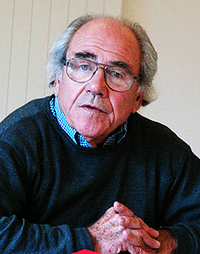
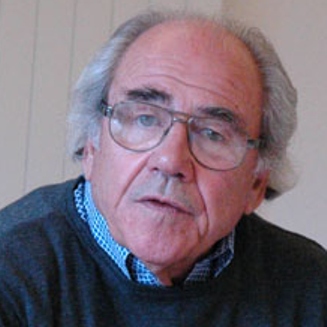
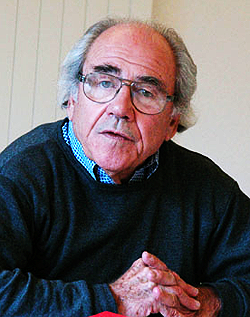
Jean Baudrillard
French sociologist and philosopher known for hyperreality.

FULBERT · CC BY-SA 4.0
Jean Baudrillard was a French sociologist and philosopher with an interest in cultural studies. He is best known for his analyses of media, contemporary culture, and technological communication, as well as his formulation of concepts such as hyperreality.
- field
- Sociology, philosophy
- nationality
- French
- known_for
- Hyperreality, analyses of media and contemporary culture
Verified Timeline
Lore & Background
His grandparents were farm workers and his father a gendarme. During high school, he became aware of 'pataphysics via philosophy professor Emmanuel Peillet, which is said to be crucial for understanding his later thought. While teaching German, Baudrillard began to publish reviews and translate works by authors including Peter Weiss, Bertolt Brecht, Karl Marx, Friedrich Engels, and Wilhelm Emil Mühlmann. During the 1980s and 1990s his books gained a wide audience, and he became an intellectual celebrity, published often in the French- and English-speaking popular press.
Reader's Guide
Baudrillard's work is frequently associated with postmodernism and specifically post-structuralism, though he opposed post-structuralism and distanced himself from postmodernism. His key concepts include hyperreality, which he developed from the idea that meaning is created through difference and self-referentiality. He argued that in late 20th century global society, technological communication has created an excessive proliferation of meaning, leading not to a global village but to a world where meaning has been obliterated and reality effaced. His writings cover consumerism, critique of economy, social history, aesthetics, Western foreign policy, and popular culture. Among his best-known works are Forget Foucault, Seduction, Simulacra and Simulation, America, and The Gulf War Did Not Take Place. His legacy includes influencing cultural studies and media theory, though he remained critical of academic labels.
Did You Know?
- He enjoyed renaissance and baroque music, with a favorite composer being Claudio Monteverdi.
- He did his writing using his old typewriter, never at the computer, stating he had a physical relation to writing.
From the Sorbonne to Nanterre: An Academic Odyssey
Jean Baudrillard's intellectual journey began in Reims, northeastern France, where his grandparents worked the land and his father served as a gendarme. At the local lycée, a philosophy professor named Emmanuel Peillet exposed him to 'pataphysics, a parody of scientific philosophy that would prove crucial to grasping his later thought. Becoming the first member of his family to set foot in a university, Baudrillard moved to Paris and studied German language and literature at the Sorbonne. That training led him to teach German at several lycées from 1960 to 1966, a period during which he also translated works by Brecht, Marx, Engels, Peter Weiss, and Wilhelm Emil Mühlmann. A decisive turn toward sociology followed, culminating in his 1966 doctoral thesis, Le Système des Objets, examined by a committee of Henri Lefebvre, Roland Barthes, and Pierre Bourdieu, and published as a book in 1968. He then joined Paris X Nanterre, the campus at the heart of the May 1968 uprising, progressing from assistant professor to full professor. In 1986 he transferred to the IRIS institute at Paris-IX Dauphine, and in his final years he increasingly refused to identify with any single discipline, though he never fully severed his academic ties.
Simulacra, Hyperreality, and the Postmodern Question
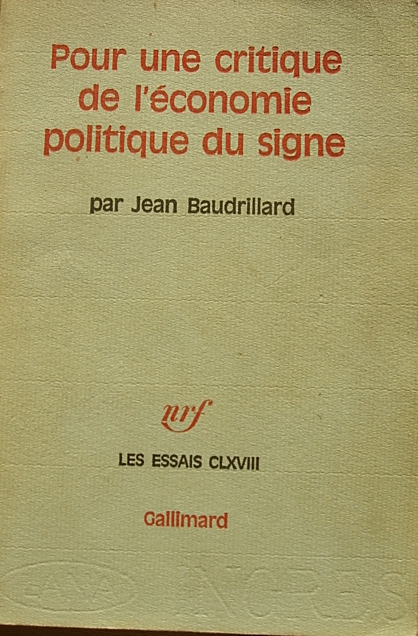
Baudrillard is most widely recognized for his penetrating analyses of media, consumer culture, and technological communication, and for formulating the concept of hyperreality. His published corpus spans an impressive range: consumerism, economic critique, social history, aesthetics, Western foreign policy, and popular culture. Among his most cited texts are Forget Foucault (1977), Seduction (1978), Simulacra and Simulation (1981), America (1986), and The Gulf War Did Not Take Place (1991). His work is routinely grouped with postmodernism and post-structuralism, and he emerged alongside a constellation of French thinkers—Deleuze, Lyotard, Foucault, Derrida, and Lacan—who shared a deep engagement with semiotics. Drawing on Saussurean ideas, Baudrillard held that meaning arises through systems of signs in relation to one another, that value is produced by difference rather than by any inherent essence. Yet he consistently pushed back against the very labels attached to him: he explicitly opposed post-structuralism and distanced himself from postmodernism, insisting his thought occupied a distinct philosophical territory.
A Life Beyond the Text: Music, Typewriters, and Love
Beyond his theoretical output, Baudrillard cultivated a rich personal world. Musically, he gravitated toward renaissance and baroque composers, with Claudio Monteverdi as a particular favorite, yet he also embraced rock, citing The Velvet Underground & Nico among his preferred recordings. He insisted on writing exclusively on an old typewriter, dismissing the computer as nothing more than a more convenient and elaborate typewriter, and insisted that the mechanical instrument gave him a physical relationship to the act of writing. He was married twice: first to Lucile, with whom he had two children, Gilles and Anne, and later to Marine Dupuis, a twenty-five-year-old he met at Nanterre in 1970 after her return from a sailing voyage around the world; the two wed in 1994. Marine went on to work as a journalist and media artistic director. In 1981, during a trip to Japan, he received his first camera and discovered a passion for photography, culminating in a 1999–2000 exhibition at the Maison européenne de la photographie in Paris. Diagnosed with cancer in 2005, he fought the illness for two years from his apartment on Rue Sainte-Beuve before dying in March 2007 at age seventy-seven.
Celebrity, Collaboration, and the Afterlife of an Idea
By the 1980s and 1990s, Baudrillard's books had reached a broad readership, and in his final years he achieved a degree of intellectual celebrity, appearing regularly in both French- and English-language popular press. His international engagements were extensive: he made his first trip to the United States in 1970 (Aspen, Colorado), visited Kyoto, Japan, for the first time in 1973, and later taught at the European Graduate School in Saas-Fee, Switzerland. He maintained an affiliation with the Collège de 'Pataphysique as its Satrap and supported the Institut de Recherche sur l'Innovation Sociale at France's national research center. He also collaborated with CTheory, a Canadian review of theory, culture, and technology, and participated in the International Journal of Baudrillard Studies from its launch in 2004 until his death. In 2004 he attended a major conference on his own work, 'Baudrillard and the Arts,' held at the Center for Art and Media in Karlsruhe, Germany. After his passing, his widow Marine Baudrillard founded Cool Memories, an association of his friends dedicated to preserving and promoting his legacy.
Gallery


Frequently Asked Questions
Who is Jean Baudrillard?
Jean Baudrillard was a French thinker who worked across sociology and philosophy, focusing on how media, technology, and consumer culture shape modern life. He is most widely recognized for developing the concept of hyperreality.
What is hyperreality in Baudrillard's work?
Hyperreality is Baudrillard's term for a condition in which simulations and media representations become more influential than the 'real' world they supposedly depict. He argued that late modern society has largely replaced direct experience with layers of signs and constructed images.
What academic disciplines did Jean Baudrillard work in?
He was trained and published primarily in sociology, but his output also falls squarely within philosophy and cultural studies. His analyses of media and technological communication bridged all three fields.
Why is Jean Baudrillard considered important in philosophy?
His writings gave scholars and the general public a vocabulary for understanding how mass media, consumer culture, and simulation reshape our perception of reality. Concepts like hyperreality remain central to ongoing discussions in media theory, cultural criticism, and postmodern thought.
More in Philosophers 25-28
Related in Philosophers
Links follow this subject's own source article.
Elsewhere in the Philosophers universe
Spotted an error? Know more?
This is a living reference — every entry is fact-audited, and reader corrections feed straight into our audit queue. Suggest an edit · See this site's audit record