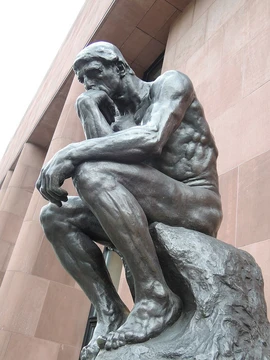
Georges Bataille
French writer and theorist of transgression, expenditure, and the sacred.

Georges Albert Maurice Victor Bataille was a French writer, essayist, librarian and theorist whose work crossed the boundaries of literature, philosophy, anthropology, sociology, political economy, religious studies and art history. He conceived writing as an exploration of the limits of human experience in which theoretical reflection, literary form and personal exposure could not be cleanly separated. His recurring subjects included sacrifice, eroticism, death, laughter, mystical experience, expenditure, sovereignty, community and the sacred.
- born
- 10 September 1897
- died
- 9 July 1962
- field
- Literature, philosophy, anthropology, sociology, political economy, religious st
- nationality
- French
- known_for
- Concepts of base materialism, heterology, the informe, nonknowledge, general eco
Verified Timeline
Lore & Background
Bataille was born in Billom, Auvergne, on 10 September 1897, the younger son of Joseph-Aristide Bataille and Marie-Antoinette-Aglaë Tournadre. His father suffered from neurosyphilis, was already almost blind when Georges was born, and his illness progressed into paralysis, severe pain, incontinence and periods of mental disturbance. Bataille's later accounts of his father are among the most troubling and unstable documents of his childhood, including descriptions of sexually obscene outbursts and bodily degradation, though his brother Martial disputed the characterization of their father as insane. The family moved to Reims in 1898; Bataille was baptized on 7 August. He converted to Catholicism in August 1914, beginning a period of intense devotion, ascetic aspiration and interest in mystical literature. After the German advance towards Reims, Bataille, his mother and his brother evacuated to Riom-ès-Montagnes; his incapacitated father remained in Reims and died on 6 November 1915. Bataille later experienced the departure as an abandonment that left him with lasting guilt. After military service in the 154th Infantry Regiment and a period at the seminary at Saint-Flour, Bataille entered the École Nationale des Chartes in November 1918. He gradually abandoned Catholic belief and qualified as an archiviste paléographe in 1922, placing second in his class. In Madrid in 1922, he attended the corrida of 7 May at which matador Manuel Granero was fatally injured when a bull's horn penetrated his eye socket; the episode became the basis of 'The Eye of Granero' in Story of the Eye. Returning to Paris in 1923, he became close to ethnologist Alfred Métraux and the Russian émigré philosopher Lev Shestov. During the interwar period, Bataille edited the journal Documents, participated in the anti-Stalinist Democratic Communist Circle, collaborated with André Breton in the anti-fascist organization Contre-Attaque, founded the journal and secret society Acéphale, and helped establish the College of Sociology. His relationship to Surrealism was conflictual but enduring; he later described himself as Surrealism's 'old enemy from within' and argued that it had posed fundamental questions about freedom, revolt, poetry and collective life.
Reader's Guide
Bataille's significance lies in his radical rethinking of human experience through concepts that challenge conventional boundaries. During the Second World War, he wrote the works later grouped as La Somme athéologique ('The Atheological Summa'): Inner Experience, Guilty and On Nietzsche, developing an atheological mysticism based on anguish, ecstasy, nonknowledge and communication without a transcendent God or promise of salvation. After the war, he founded the journal Critique and published major works on general economy, eroticism, literature, prehistoric art and the history of representation. His writings combine Nietzschean affirmation, Hegelian negativity, Freudian psychoanalysis, the sociology of Émile Durkheim and Marcel Mauss, and sustained engagement with Christian mysticism and apophatic theology. Among the concepts associated with his work are base materialism, heterology, the informe, nonknowledge, general economy and the 'accursed share'. Bataille's legacy is extensive: his work shaped Maurice Blanchot, Michel Foucault, Jacques Derrida, Jean-Luc Nancy, Julia Kristeva, Jean Baudrillard and other figures in postwar French thought, literary theory and social theory.
Did You Know?
- Bataille's first publication was a devotional pamphlet titled Notre-Dame de Rheims, published privately in 1918 and dedicated to the ruined cathedral of his childhood city and to the Catholic writer Léon Bloy.
- He attended the Madrid corrida of 7 May 1922 where matador Manuel Granero was fatally injured when a bull's horn penetrated his eye socket; Bataille was too distant to see the injury clearly and reconstructed the event imaginatively.
- Bataille translated Lev Shestov's The Idea of the Good in Tolstoy and Nietzsche into French with Tatiana Beresovski-Chestov, published in 1925, though his Russian was rudimentary.
- He described his encounter with Nietzsche in 1923 as 'decisive', allowing him to retain the ardour of religious experience while directing it against consolation, salvation and moral submission.
- Bataille qualified as an archiviste paléographe in 1922, placing second in his class, with a thesis on the thirteenth-century verse narrative L'Ordre de chevalerie.
Frequently Asked Questions
Who is Georges Bataille?
Georges Bataille (1897–1962) was a French writer, essayist, and librarian whose work spanned philosophy, anthropology, sociology, and art history. He is best known for probing themes like sacrifice, eroticism, death, and the sacred through a lens he called base materialism. He explicitly refused to be read as a systematic philosopher, framing his writing instead as an exploration of the limits of human experience.
What is Bataille's concept of the 'accursed share'?
The 'accursed share' (la part maudite) is Bataille's claim that every society must expend a surplus of energy in non-productive ways—through ritual, spectacle, war, or art. He argued this expenditure is not waste but a structural necessity that prevents an economy from collapsing under its own accumulation. The idea is developed most fully in his 1949 work La Part maudite.
What was Acéphale?
Acéphale was a small journal and secret society Bataille co-founded in the late 1930s alongside Pierre Klossowski and others. The name means 'headless,' and members adopted a shared emblem of a headless figure, reflecting Bataille's preoccupations with sacrifice, eroticism, and the dissolution of individual sovereignty. The group was short-lived but deeply shaped his later theoretical writing.
What does Bataille mean by 'nonknowledge' (non-savoir)?
Nonknowledge, for Bataille, is not simple ignorance but an active, ecstatic encounter with what overflows rational comprehension—death, the body, the sacred. He set it against the Enlightenment ideal of total knowledge, insisting that genuine experience always exceeds the categories the mind tries to impose. The concept threads through his essays on mysticism, eroticism, and laughter.
Why is Bataille important to later thinkers?
His ideas on expenditure, sovereignty, and the sacred became foundational for figures ranging from Jean-Paul Sartre and Maurice Blanchot to Jacques Derrida and Jean Baudrillard. His framework of general economy and his critique of purely productive reason also anticipated later work in political economy and cultural theory. He remains a key reference for anyone exploring transgression, community, and the irreducible excess at the edges of rational life.
More in Philosophers 1-24
Related in Philosophers
Links follow this subject's own source article.
Elsewhere in the Philosophers universe
Spotted an error? Know more?
This is a living reference — every entry is fact-audited, and reader corrections feed straight into our audit queue. Suggest an edit · See this site's audit record